
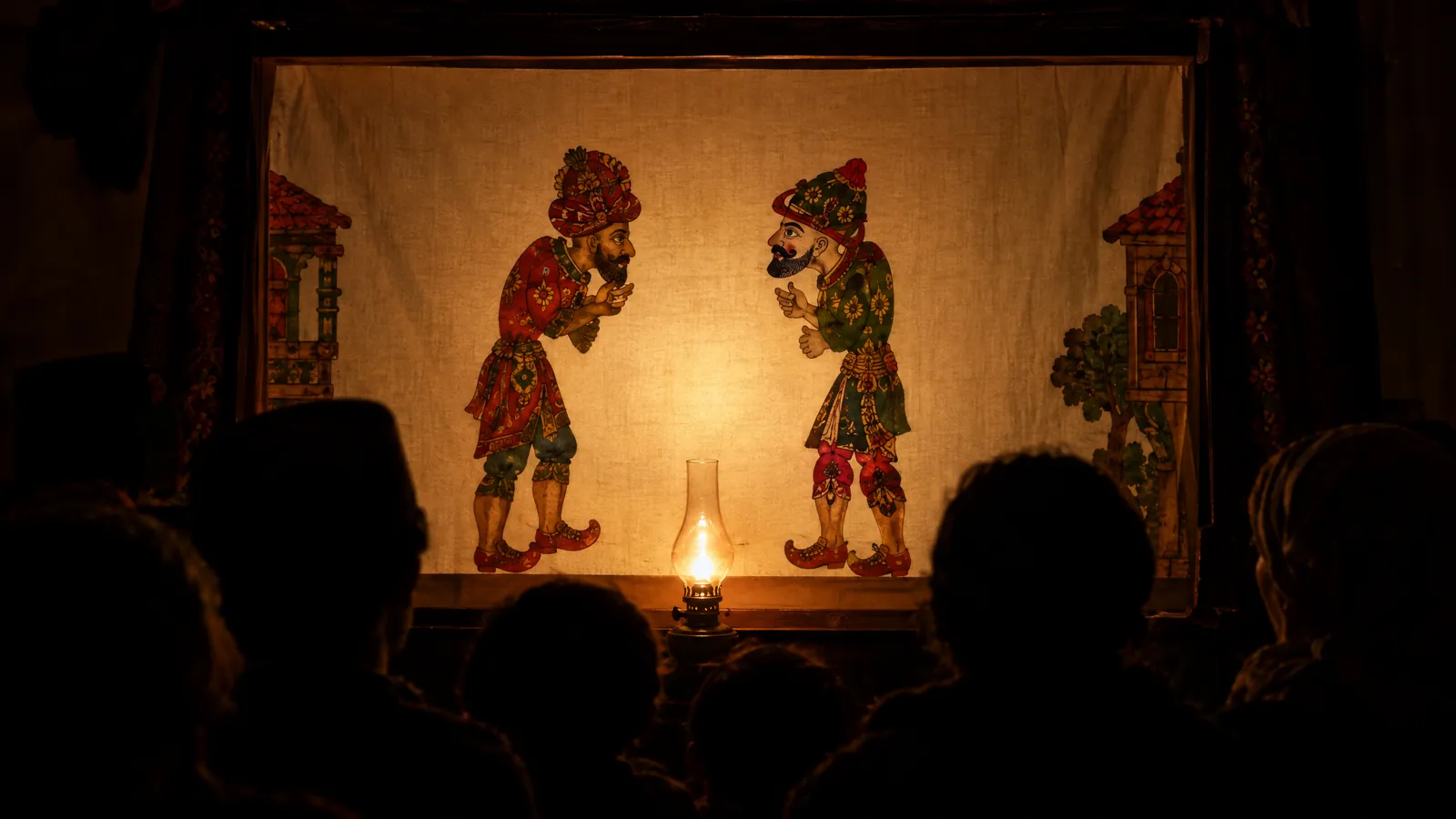
Short answer: Shadow play is a performing art in which flat figures cut from leather, cardboard or paper are pressed close to a taut screen lit from behind and moved with rods; the audience sees only the shadow and the colored light on the screen. Karagöz in Türkiye, wayang kulit in Indonesia, and leather and paper shadow puppetry in China are well-known members of this family.
A dark room, a single lamp shining on the wall and a bird you make with your hands: most of us first played with shadows this way. Over the centuries the same simple idea grew into a family of theater stretching from Asia to the Mediterranean. In this article we explain how shadow play works, its main traditions around the world, the structure of Karagöz in brief, and how this language is carried onto the screen today.
How does shadow play work?
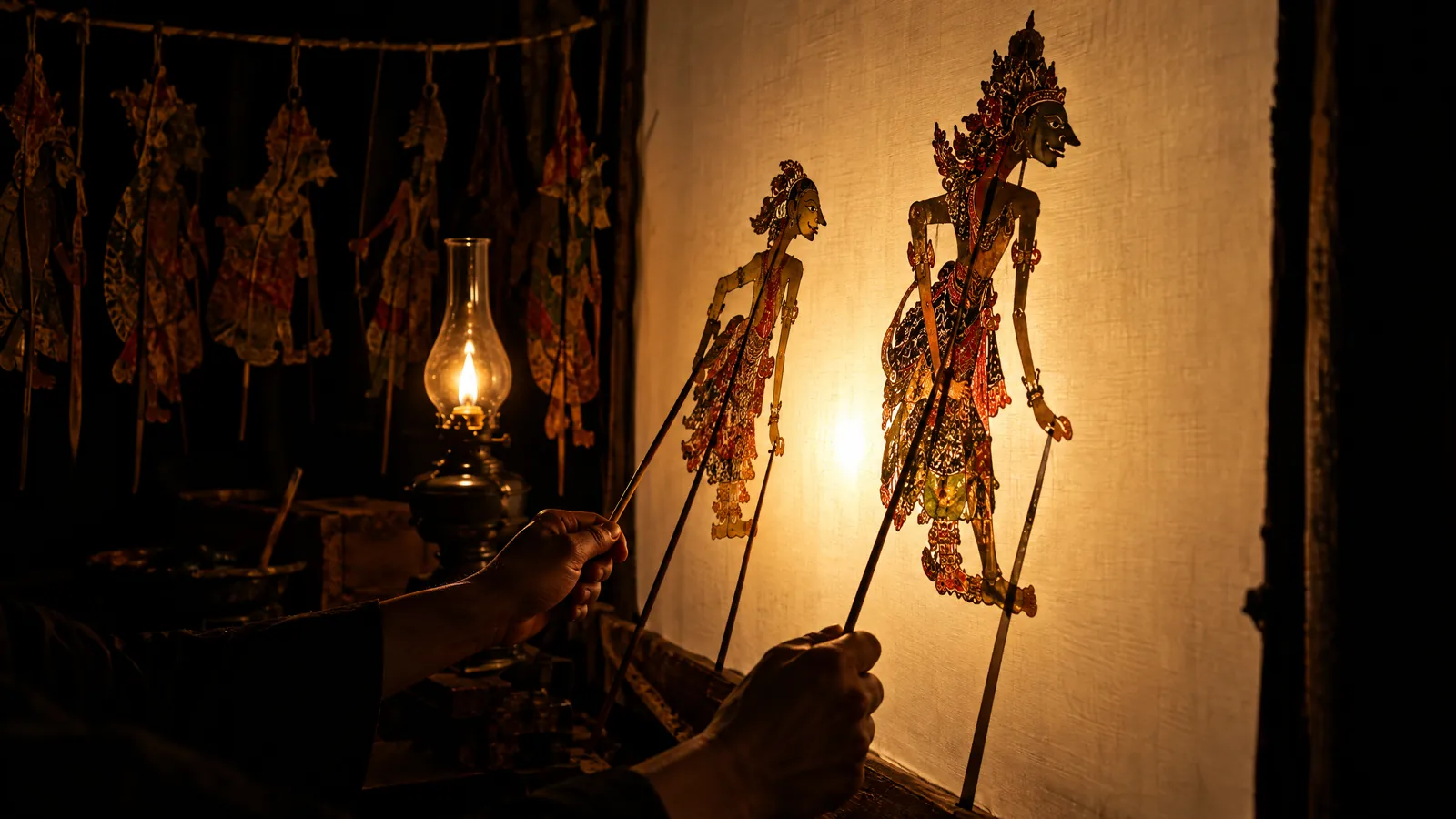
Shadow play is built from three things: a taut screen lit from behind, a flat figure brought close to the screen, and a performer who moves the figure from behind the screen. The audience sits in front of the screen and sees not the figure itself but its shadow on the screen, or the colored light passing through it. The closer the figure comes to the screen, the sharper the shadow; the further away, the larger and blurrier it gets.
Although the technical components of the screen vary from tradition to tradition, the skeleton is the same:
- Screen. A thin, white or translucent fabric stretched over a frame. In Karagöz it is cotton cloth.
- Figure. Cut from leather, cardboard or paper; parts such as arms, legs and head are often jointed. In Türkiye these figures are called tasvir.
- Rod. Thin sticks that hold and move the figure. Karagöz uses horizontal rods fitted into holes in the tasvir.
- Light source. Traditionally an oil lamp or a candle; the flicker of the flame brings the shadow to life.
- Sound and music. A frame drum, cymbals, a whistle, a drum or a whole orchestra, depending on the tradition.
- Puppeteer. The master who moves all the figures and gives all the voices. In Karagöz the master is called the hayalî, in Java the dalang.
In which countries is shadow play performed?
Shadow play lives across a wide geography, from China to Indonesia, from India to Cambodia, and from Syria to Türkiye and Greece. The traditions differ in figure material, screen size, music and the sources of their stories; some are tied to religious ceremonies, while others rest on coffeehouse humor.
| Tradition | Country | Figure | Distinctive feature | UNESCO listing |
|---|---|---|---|---|
| Karagöz | Türkiye | Camel or ox hide, painted | Wordplay, imitated dialects, frame drum; one master gives all the voices | 2009, Representative List |
| Wayang kulit | Indonesia | Flat leather, movable arms | Dalang, gamelan music, Indian epics and local myths | Proclaimed 2003, Representative List 2008 |
| Chinese shadow puppetry | China | Leather or paper, colored | Singing and falsetto, troupes of two to nine people | 2011, Representative List |
| Sbek Thom | Cambodia | Carved leather, about two meters, unjointed | Considered sacred, performed on a few special days a year | Proclaimed 2005, Representative List 2008 |
| Damascus shadow play | Syria | Handmade figures | Naive Karakoz and cunning Eiwaz, social satire | 2018, Urgent Safeguarding List |
| Tholu bommalata | India | Goat, cow or buffalo hide, large and jointed | Stories from the Ramayana and the Mahabharata | No separate listing |
| Karagiozis | Greece | Flat cut-out figures | Adapted from Karagöz in the late 19th century and localized | No separate listing |
As of October 2026, at least five shadow play traditions have their own entries on UNESCO's Intangible Cultural Heritage lists: Karagöz (2009), wayang (2008), Sbek Thom (2008), Chinese shadow puppetry (2011) and Syrian shadow play (2018). When Syrian shadow play was inscribed in 2018, only 1 active puppeteer remained in Damascus; that was why it entered the Urgent Safeguarding List. It is no coincidence that the character names in the Syrian tradition recall Karagöz and Hacivat; across the Ottoman world, shadow play was a shared stage language.
What are the parts of a Karagöz play?
A traditional Karagöz play has four parts: the mukaddime (prologue), the muhavere (the verbal duel between Karagöz and Hacivat), the fasıl (the main story) and the ending. Before the play begins, a decorative figure called the göstermelik stands on the screen; it is lifted at the sound of a whistle called the nareke, and Hacivat opens the play by reciting the screen poem (perde gazeli).
Gathering the terms of Karagöz into a short glossary:
- Hayalî. The master who performs the play; voices all the characters alone and may be assisted by apprentices.
- Tasvir. A figure cut from leather that has been made translucent and colored with natural dyes.
- Göstermelik. The figure placed on the screen at the start of the play, hinting at the setting and the theme.
- Nareke. The shrill whistle that signals the göstermelik to be lifted from the screen.
- Perde gazeli. The opening poem Hacivat recites about the meaning of the screen.
For the characters, the origin legend and where the play was performed in the Ottoman period, see our Karagöz and Hacivat article; we do not repeat that detail here.
What is the difference between shadow play and puppet theater?
In puppet theater the audience sees the figure itself; the puppet is three-dimensional, may be a marionette or a glove puppet, and stands on stage as a real object. In shadow play the figure is flat, and there is always a screen between it and the audience. What is seen is not the object but the picture the light draws on the screen as it passes through and around it.
This difference also shapes the language of storytelling. A shadow figure is mostly seen in profile, its facial expression does not change, and the character is recognized by silhouette and color. Movement comes from the joints and is jerky; the sense of depth is created only by the figure's distance from the screen. That is why, in shadow play, the burden of humor and emotion is carried largely by words, voice and music.
How is shadow play kept alive today?
In most countries shadow play is handed down through master and apprentice, within families and communities. Karagöz, once performed in coffeehouses, gardens and on Ramadan nights, is now staged in large cities mostly in performance halls, schools and shopping centers, according to its UNESCO entry.
Some traditions have had a harder road. In Cambodia many Sbek Thom figures were destroyed in the Khmer Rouge period; after 1979 the few surviving artists revived the tradition. In Syria, the spread of new forms of entertainment, war and displacement set the tradition back so far that only a single active puppeteer remained in Damascus at the time of inscription. These examples show that shadow play is not a collection of objects but a living performance: the figures can sit in a museum, but the play lives only with the master who performs it. The main ways traditions are kept alive are these:
- Master-apprentice training and figure-making workshops.
- Regular performances in schools and cultural centers.
- Recording and archiving traditional performances.
- Interpretations that speak to today's audiences with new stories, including animation and digital content.
How is shadow play brought into animation?
When bringing shadow play to the screen, the real work is to keep the screen's own rules rather than producing a generic "shadow animation" of black silhouettes. Warm light from behind, colored and perforated figures, profile views, jerky movement from the joints and a screen that stays fixed are the foundations of this language. The moment the camera leaves the screen, the viewer stops watching a shadow play and starts watching an ordinary cartoon.
We covered the general production stages of animation in our how to make a cartoon guide. In the shadow play style, three rules are added: set the characters clearly apart by silhouette and color, keep the dialogue short and full of banter, and use the slight flicker of the light and the figure's distance from the screen as tools for depth.
How do you make shadow play style animation with Shadowmation?
Shadowmation is the Karagöz shadow play style in Yeşilçam Animation: a screen lit from behind, perforated and colored leather figures, a flickering lamp. The scenes are drawn not by a video model but by a 2.5D animation engine; so the figures' mouths are not animated, and the movement keeps the feel of a jointed figure pressed against the screen.
- Open the Shadowmation card on the Animation page and watch the example.
- Write your story in the "What shall we tell?" field; short stories with two characters built around a conflict suit this style best.
- Define up to four characters; give each a name, a description of their look or a reference image.
- Choose the speech mode: Narrator, Dialogue, Both or Silent.
- Choose the ratio (16:9, 9:16 or 1:1), a length between 10 and 120 seconds, and the Premium or Professional level.
- Check the estimated price at the bottom of the form and start production.
As of October 2026, Shadowmation is one of the 20 styles in Yeşilçam Animation and produces films between 10 and 120 seconds long with up to 4 characters. Instead of a fixed tariff, the price is shown as an itemized estimate for each job; the estimate is a ceiling, and if actual usage comes in lower the difference is refunded automatically, while the fee for a failed job is returned in full. Shadowmation has no frame review line, because the scenes are not generated with a video model. Details are in the animation cost guide, and why the style was built in the Shadowmation article.
What can digital shadow play not do?
A digital shadow play imitates the look of the tradition, but it does not replace the live performance of a screen master. The hayalî's improvisation, the way the words change with the audience's reaction, every voice coming from a single throat, and leather trembling in front of a real flame cannot be recreated in a screen production.
That is why another route is better for some work. At a school event meant to teach the tradition, a live performance or a recording of a master hayalî conveys far more than an animation. In museum and archive work, photographing real figures and documenting the performance are essential. Care is also needed when using the traditional types: the regional and community types of Karagöz carry the humor of their own era; it is your responsibility not to slip into language that belittles a community today. Shadowmation is best used when you want to tell a new story with respect for the tradition; you can read about the bond between the Yeşilçam name and this screen in our Yeşilçam heritage article.
Frequently asked questions
Are shadow play and Karagöz the same thing? No. Shadow play is the name of the general art form; Karagöz is that art form's tradition in Türkiye. Wayang kulit in Indonesia, Chinese shadow puppetry and Sbek Thom in Cambodia are also shadow play, but they differ from Karagöz in material, music and subject.
Why do shadow play figures look colorful? Traditional figures are cut from leather that has been thinned until translucent, and then painted. When pressed against the screen and lit from behind, the light passes through the leather; instead of a black silhouette, the audience sees a colored figure whose perforated patterns can be made out.
Which shadow plays are on the UNESCO list? As of October 2026, Karagöz (2009), wayang (2008), Sbek Thom (2008) and Chinese shadow puppetry (2011) are on the Representative List, and Syrian shadow play has been on the Urgent Safeguarding List since 2018. There is no separate listing for Karagiozis in Greece or tholu bommalata in India.
How do you set up a simple shadow play at home? A thin white cloth stretched over a frame, a single light source placed behind it, and figures cut from cardboard and attached to thin rods are enough. The closer you bring a figure to the screen, the sharper the shadow; the room should be dark, with one fixed light.
Do I have to use Karagöz and Hacivat with Shadowmation? No. Shadowmation provides the look of shadow play; you decide the characters, the story and the speech mode. By describing your own characters, you can also tell a contemporary story in the language of the screen.