
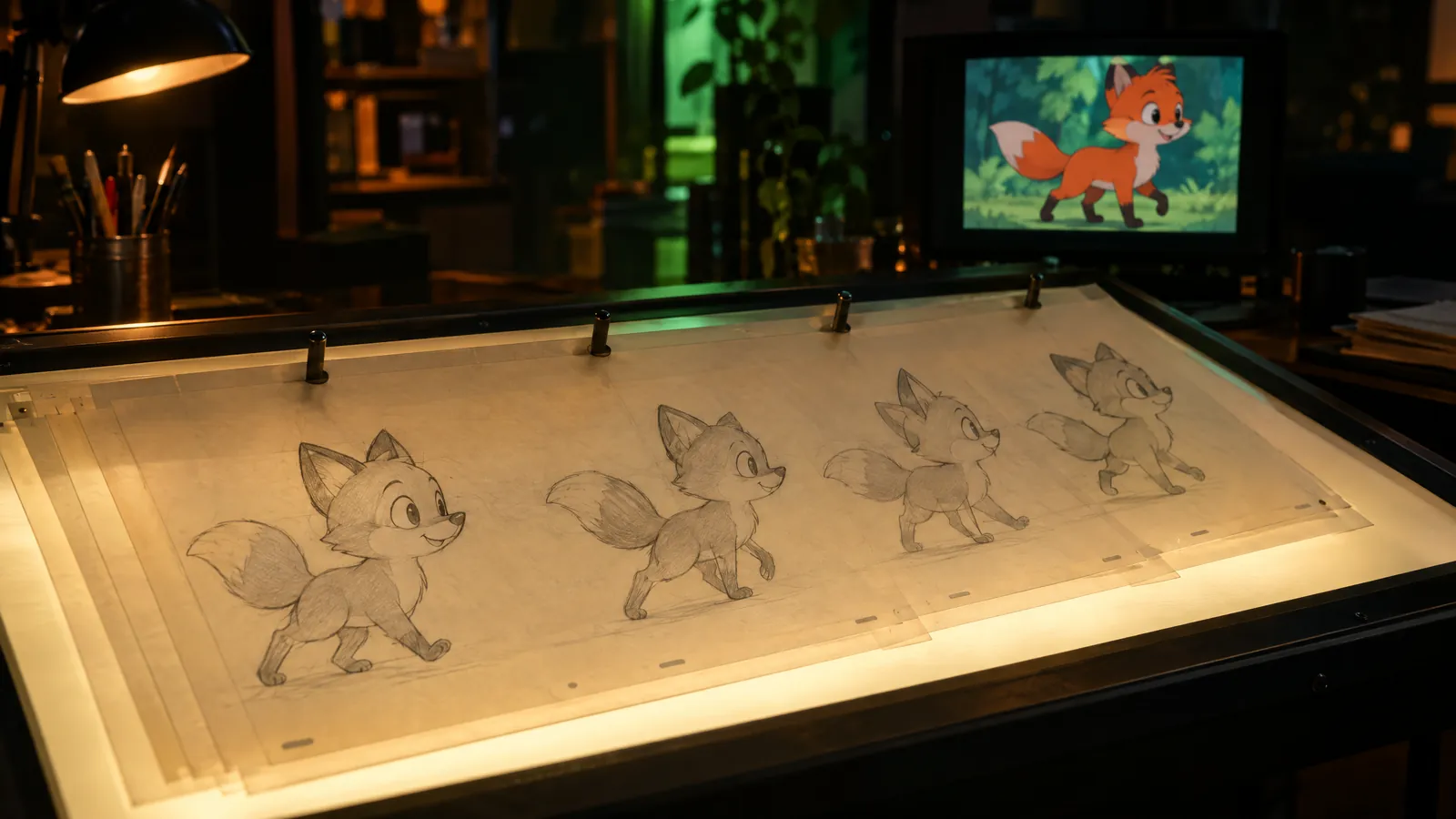
Short answer: A cartoon is made in nine stages: idea, screenplay, character design, storyboard, animatic, voice recording, animation, backgrounds and editing. The traditional way needs 12 or 24 drawings per second, and one minute can take weeks. With AI you can finish a short cartoon in the browser on the same day, by choosing a style and writing the story.
Most people who decide to make a cartoon start by opening a drawing program and get stuck in the same place in the first week: the character changes a little in every frame, the walk jitters, and when the sound is added later the mouth does not match. The problem is not talent but order. A cartoon is a production line built on paper before any drawing. This guide walks through that line stage by stage, then shows where the same line gets shorter with AI and where it does not.
What stages does cartoon production go through?
A classic cartoon goes through nine stages: idea, screenplay, character design, storyboard, animatic, voice recording, animation, backgrounds and color, and finally editing and sound. The order matters; the voice is recorded before the animation so that the mouth and movement can be drawn to the sound. Because every stage uses the output of the one before it, a screenplay error noticed late is the most expensive error.
| Stage | What is produced | Workload, the traditional way | What changes with AI |
|---|---|---|---|
| Idea | A one-sentence story | Light, one person | Unchanged; the decision is yours |
| Screenplay | Scene-by-scene text and lines | Several drafts | A draft with a scene breakdown arrives in minutes; the fixing is up to you |
| Character design | Front, side and back views and expressions | Days of drawing | A character sheet is generated and stored for consistency |
| Storyboard | A frame-by-frame shot plan | A separate artist | Produced automatically per scene |
| Animatic | The storyboard timed to the sound | Editing work | The preview plays directly |
| Voice recording | Narration and lines | Actors and a studio | A voice model reads them; preparing the text is essential |
| Animation | Key poses and in-betweens | The team's biggest load | A video model or code-driven drawing; subtle acting is limited |
| Backgrounds and color | Locations, color palette | Separate artists | Come with the chosen style |
| Editing and sound | Music, effects, finished film | Editing and sound team | Scenes join automatically, music is generated |
Saving time in the first two stages is tempting, but most of the gain is not there; it is in the animation stage. To build a screenplay at short film scale, see how to write a screenplay, and to draw the scenes shot by shot, the what is a storyboard article.
What types of cartoons are there?
Cartoon types are distinguished by technique: frame-by-frame 2D animation, cut-out animation made with jointed pieces, computer-modeled 3D animation, stop-motion that photographs an object frame by frame and its clay version, claymation, and shadow animation that moves figures in front of a light. The motion comic, which animates comic panels, is a language of its own. The type determines both the look and the workload.
| Type | How it is made | Strength | Yeşilçam Animation equivalent |
|---|---|---|---|
| 2D frame by frame | Every pose is drawn on paper or on screen | Flexibility, humor, exaggeration | Toonmation, Celmation |
| Cut-out | Jointed pieces are moved | Economical, fairy-tale feel | Foliomation, Puppetmation |
| 3D | A model, a rig and lighting are built | Depth, free camera | Toymation |
| Stop-motion and clay | An object is photographed frame by frame | Handmade warmth | Claymation |
| Shadow | A figure is moved with light from behind a screen | Simple, cultural | Shadowmation |
| Motion comic | Panels and speech balloons are animated | Lots of storytelling with little motion | Panelmation |
History confirms this variety. Émile Cohl's short Fantasmagorie (1908), which film historians count as the first cartoon, consists of about 700 drawings, each exposed twice. Lotte Reiniger's The Adventures of Prince Achmed (1926), the oldest surviving animated feature, was made with cardboard silhouettes and took three years to produce. The stop-motion and clay animation aesthetics article explains how the clay look is captured, and the Karagöz and Hacivat article covers the roots of the shadow language.
How many frames per second are drawn in a cartoon?
Cinema film plays at 24 frames per second; this rate became standard between 1927 and 1930 with the move to sound film. In a cartoon not every frame is drawn separately: characters are mostly animated on twos, meaning each drawing stays on screen for two frames, so 12 drawings per second are enough. For fast movement animators switch to ones, that is 24 drawings per second.
The math is simple but heavy: one minute on twos means 60 × 12 = 720 drawings, and 1,440 drawings if drawn on ones. Backgrounds, color and corrections come on top of that. To reduce this load, limited animation became widespread: it redraws only the parts that change, such as the mouth and eyes, and loops the same movement. This is also why cut-out and shadow techniques were long considered economical: a piece is drawn once and then only moved.
How do you make your first one-minute cartoon?
Limit your first cartoon to one minute and tell a single event: one character, one wish, one obstacle, one outcome. If you think in 5 to 10 seconds per scene, one minute corresponds to 6 to 12 scenes. Screenplay and storyboard come first, then sound, and the images last; this order is the same the traditional way and with AI.
- Reduce the idea to one sentence. For example: "A seagull chick afraid of flying spreads its wings when its sibling falls into the sea."
- Split the story into scenes. For each scene, write a one-sentence action and, if there is one, a single line.
- Lock the character. Name, age, colors, clothing and a voice description; these do not change for the whole film.
- Make a storyboard. Decide each scene's shot type (wide, medium, close) and duration.
- Prepare the sound first. Write the narration and lines for the voice; spell out numbers and abbreviations.
- Do a short test. Test the style with a 20- to 30-second draft.
- Watch and fix. Watch the preview from start to finish, change the problem scene, then take the final file.
The fifth step is the one skipped most often; we collected the rules for preparing Turkish narration for the voice in the AI voiceover in Turkish article. For video types other than cartoons, the guide to making videos with AI describes the general flow.
What software do you need to make animation?
The software you need depends on the technique you choose. Frame-by-frame 2D needs desktop 2D animation programs and a drawing tablet, 3D needs modeling and animation packages, and stop-motion needs a camera and a frame capture app. For short animations on a phone, mobile drawing and stop-motion apps are enough. AI studios run in the browser with no installation.
- Desktop 2D animation programs: Give full control over every frame; the learning curve is long and they need a tablet.
- 3D modeling and animation packages: Need a powerful computer and knowledge of modeling and rigging.
- Mobile apps: Drawing with your finger or stop-motion with the phone camera; enough for short social media pieces.
- AI studios in the browser: No drawing skills needed; the decisions are yours and the handwork is the model's.
Which style should you choose when making a cartoon with AI?
Choose the style by the purpose of the work: a classic cartoon for humor, anime for an emotional story, toy-like 3D or paper puppets for children's content, shadow play for a cultural story. In Yeşilçam Animation you choose a style and write the story in a few sentences; the studio prepares the scenes, drawings, narration and music, and the preview plays right away in the browser.
| Job | Style | Why |
|---|---|---|
| A funny short cartoon | Toonmation | Classic cartoon, exaggerated movement |
| An emotional story with young characters | Celmation | Classic anime language |
| A fairy tale for children | Toymation or Puppetmation | Cute 3D or jointed paper puppets |
| A poetic short film with your own hero | Foliomation | Layered paper cut-out, parallax depth |
| Handmade warmth | Claymation | The look of clay stop-motion |
| A local, cultural story | Shadowmation | The language of Karagöz shadow play |
| A comic book adaptation | Panelmation | Panels, speech balloons, sound effect lettering |
| A quick narrated film from existing text | Inkmation | Brush drawing, 11 platform aspect ratios |
After choosing the style come the length and the budget. As of October 2026 the Animation studio offers 20 styles; the target length is chosen between 10 and 120 seconds, and the ratio can be 16:9, 9:16 or 1:1. The price varies with the style, the length and the level: the form shows an itemized token estimate before production, in styles that work with a video model the Cinema level costs about twice as much as Premium, and the fee for a failed job is refunded. A detailed comparison of the styles is in the choosing an animation style guide, and the steps for your first piece in the introduction to the Animation studio guide.
Token math for a one-minute draft film
You can calculate the same job yourself in the story-to-film pipeline, using the line items of the price list. For a draft film with one character, 12 scenes and 5 seconds per scene:
- Character bible (core): 160,417 tokens
- Storyboard for 12 scenes: 12 × 4,376 = 52,512 tokens
- 12 keyframes: 12 × 11,667 = 140,004 tokens
- 12 draft videos (5 s): 12 × 122,501 = 1,470,012 tokens
- Music track: 29,167 tokens, assemble the film: 5,834 tokens, 1080p render: 202 tokens
Once the items are added up, the picture is clear. According to the October 2026 price list, this sample film costs 1,858,148 tokens in total; about $11.15 at the Basic rate, and 1,486,518 tokens with the Pro plan's ×0.8 multiplier. About four fifths of the total is the video line; so the most effective way to cut the cost is to shorten the length or reduce the number of scenes. In dialogue scenes, each lip sync adds 29,167 tokens. The Free plan's monthly 250,000 tokens are not enough for a film of this size; there you need to start with short tests or with styles that do not generate images. Current prices are on the pricing page, and the estimate logic specific to animation in the animation cost guide.
What are the limits of making cartoons with AI?
AI speeds up short cartoons, fairy-tale videos, social media episodes and idea tests; but on its own it does not carry a long series, a character's subtle acting or a broadcast-quality film. A video model cannot hit, in every scene, the emotion an animator conveys with a glance or a pause; small inconsistencies from scene to scene may also remain.
- Long series: Continuity of characters, locations and color across episodes needs an art director's oversight.
- Subtle acting: Comic timing, facial expressions and body language are still the animator's job.
- Broadcast quality: Technical delivery requirements and sound mixing for television or cinema need a professional studio.
- Fast action: In fight and chase scenes the results are more variable, and several attempts may be needed.
- Your own drawing style: If you want to preserve an original line that comes from your own hand, use AI for the storyboard and the animatic, and do the final drawing yourself.
For most projects the right route is a mixed one: you build the screenplay, storyboard and animatic quickly with AI and show the idea to an audience, then take the idea that works to an animation team or to your own drawing. You can see all the styles with examples on the Animation page.
Frequently asked questions
Do you need to know how to draw to make a cartoon? The traditional way, yes; you need enough drawing and motion knowledge to keep the character the same in every pose. In AI studios the model does the drawing; what is expected of you is the story, the character description, the choice of style, and watching the result with a critical eye and fixing it.
How many drawings does a one-minute cartoon need? In a film that plays at 24 frames per second, animating on twos needs 12 drawings per second; one minute comes to 720 drawings. If you draw fast movements on ones, the number rises to 1,440. Backgrounds and color are not included in this count.
Can you make a cartoon on a phone? For short pieces, yes. With mobile drawing apps you can draw frame by frame with your finger, and with stop-motion apps you can animate objects using the phone camera. For a long cartoon with many scenes, a large screen, a tablet and a computer make the work markedly easier.
What is the cheapest cartoon style with AI? In Yeşilçam Animation the styles that do not generate images are the most economical: Papercraft, Typemation, Fluxmation and Dioramation. For a story with characters, starting with a short test at the Professional level lets you test the style the cheapest way.
Are cartoons and animation the same thing? Not exactly. Animation is the name for every technique that creates the illusion of motion by showing still images in succession; 3D, stop-motion and clay are included. In everyday language, a cartoon usually means animation made with drawings that tells a story.