
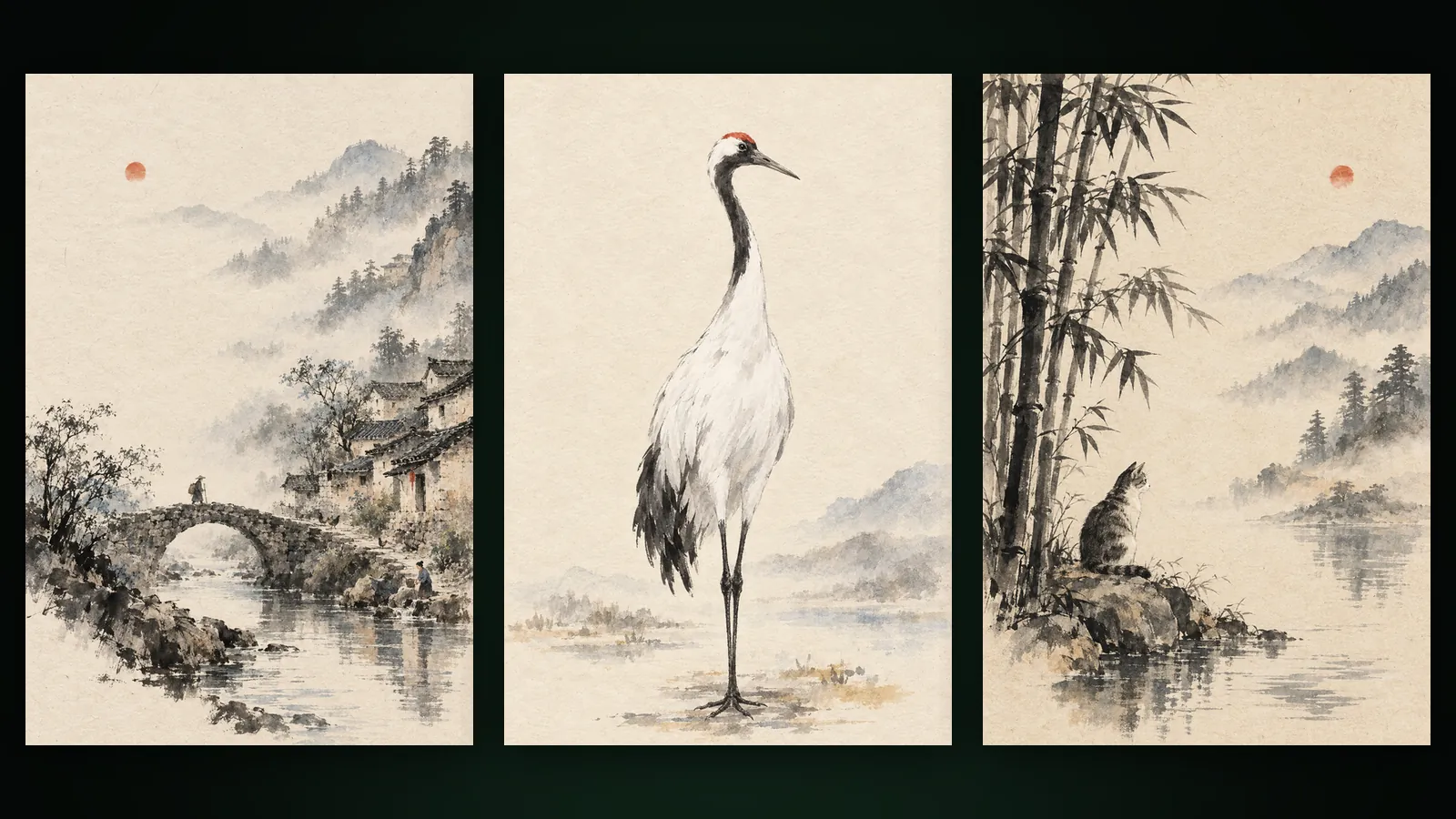
Sumi-e is the Japanese name for East Asian ink wash painting made with black ink and water; in Chinese it is called shuimohua, "water and ink painting". Shan shui means "mountain and water" and refers to the oldest and most revered genre of that tradition, Chinese landscape painting: mountains, rivers, mist and the small people within them.
This article covers the history of ink painting, the Song dynasty masters, the theory of the "three distances", texture strokes, the seal and empty space, and how this aesthetic can be carried into animation and generative AI.
What is the difference between sumi-e and shan shui?
Sumi-e is a technique: ink diluted with water to produce tones from dark to light, and a brush used in a single pass without correction. Shan shui is a subject: landscape. A shan shui painting can be made in ink, but it can also be in colour; blue-green landscape (qinglü shanshui) is a coloured branch painted with mineral pigments. In the West the two terms are often used interchangeably, but sumi-e covers any subject, from bamboo, flowers and birds to figures or a single branch.
How did the ink painting tradition develop?
Ink painting emerged as a distinct art in China during the Tang dynasty; the poet and painter Wang Wei is traditionally credited as a pioneer of monochrome landscape. The first of the six principles of painting written by Xie He in the sixth century, "spirit resonance" (qiyun shengdong), places a painting's life above technical accuracy, and that idea guides the whole tradition.
The golden age is the Five Dynasties and Northern Song period. Li Cheng, Dong Yuan, Juran and Fan Kuan established the monumental landscape style. Fan Kuan's "Travellers Among Mountains and Streams", with a giant mountain mass towering over the viewer, is the emblem of that style. Guo Xi's "Early Spring", dated 1072, gathers the changeability of season and mist into one painting. In the Southern Song, Ma Yuan and Xia Gui became known for poetic compositions that concentrate in one corner of the picture and leave the rest empty.
From the fourteenth century the tradition reached Japan through Zen monks. Sesshū Tōyō, a master of the Muromachi period, reinterpreted the landscape painting he had seen in China with a Japanese sensibility. The name sumi-e comes from this Japanese branch.
What are the three distances (gao yuan, shen yuan, ping yuan)?
In the text that collects Guo Xi's thoughts on landscape painting, a mountain can be painted from three different views. Unlike the single vanishing point of Western perspective, these three distances set up an order that lets the viewer's eye wander through the painting.
| Distance | View | Effect |
|---|---|---|
| Gao yuan (high distance) | Looking up from the foot of the mountain to its peak | Majesty, height, vertical weight |
| Shen yuan (deep distance) | Looking over the front mountain into the valleys behind | Depth, space opening layer by layer |
| Ping yuan (level distance) | Looking across from a near hill to far mountains on the horizon | Calm, breadth, a horizon dissolving into mist |
In long handscrolls the viewer unrolls the painting from right to left and goes on a journey; the painting shows a route, not a moment. That is why shan shui is surprisingly well suited to a travelling camera and an endless landscape.
What are the components of an ink painting?
Brush, ink, stone and paper
The brush, ink stick, ink stone and paper (or silk), known as the "four treasures of the study", are the basic tools of the tradition. Ink is ground on the stone with water, and the painter controls its density. Absorbent rice paper allows no correction; every stroke is permanent.
Cun texture strokes
Cun are the brush strokes that give rocks and mountains their surface, volume and texture. The best known are hemp-fibre strokes (long, soft, parallel lines, associated with Dong Yuan and Juran), axe-cut strokes (sharp, angular, dry strokes of the Southern Song painters), raindrop strokes (dense dots, Fan Kuan) and cloud-head strokes (curling, rounded masses, Guo Xi). Which cun a painter chooses defines the character of the mountain.
Emptiness and mist
In ink painting the unpainted paper is part of the picture too. Mist, water and sky are often expressed through emptiness. Empty space balances the composition, suggests distance and leaves room for the viewer's imagination.
Seal and inscription
Red seals are the signatures of the painter and of the collectors who later owned the work. Poetry, calligraphy and painting meeting on one surface are known as the "three perfections". A single red seal in a black-and-white composition becomes the point where the eye rests.
How do ink tones and brush techniques work?
The secret of making a rich painting with a single black ink lies in tone. The tradition speaks of "the five colours of ink": the same ink takes on different values, from burnt black to an almost transparent grey, depending on how much water is used. The painter uses those values like colours; the nearby rock is dark, the distant mountain light, the mist almost empty.
- Dry brush: strokes drawn with little ink and little water, with broken, textured edges. They give character to rocks, tree trunks and aged faces.
- Wet brush: marks that spread into the paper and soften at the edges. Used for mist, water and distant mountains.
- The boneless technique: building a form directly from patches of colour or tone, without drawing an outline.
- Splashed ink: suggesting a landscape with quick, almost abstract marks; Sesshū is among the best-known practitioners of this technique.
Why are people and buildings so small in shan shui?
In a shan shui painting the mountain is the main character; people are small figures walking a path, fishing from a boat or sitting in a pavilion. That scale is a deliberate choice. In Daoist and Confucian thought, people are not masters of nature but part of it. Paths, bridges and pavilions are stops that guide the viewer's eye through the painting: the viewer puts themselves in the place of that small figure and walks through the landscape. That is why a good shan shui always has somewhere you could "enter".
How does ink painting carry into animation and AI?
There are two ways to imitate ink painting digitally. The first is to draw it with code: mountain shapes, brush textures, layers of mist and paper grain are generated by rules. This is controllable, can extend endlessly and can go all the way to print as vectors; but it cannot draw details such as figures and faces. The second is generative image and video models: they draw scenes and characters freely, but when asked for "ink painting" they tend to put the same mountain and sun into every frame, drift into photographic light or lose the paper texture.
- Put the main subject in the foreground and describe it in dry brush; leave distant elements to mist and wet ink.
- If you use colour, keep it limited: pale indigo and ochre only on clothing or objects, and a single red accent.
- Leave empty space on purpose; filling everything destroys the ink effect.
- In video, keep motion slow and calm; a fast camera and hard light turn the painting into a photograph.
- List the photographic look, 3D rendering and glossy light among the things you want to avoid.
What are the most common mistakes?
- Putting a mountain, a sun and a boat in every picture: ink painting is a way of seeing, not a template.
- Filling grey tones flatly: the way ink spreads into paper and softens at the edges is lost.
- Filling the empty space and crowding the composition.
- Scattering red seals in every corner as decoration; a seal means something when it is single and well placed.
- Confusing the Japanese and Chinese branches, or reducing ink painting to a generic "Asian look".
What should you keep in mind when drawing on ink painting?
Ink painting is an art that has lived for centuries, with its own theory and tradition of mastery. Digital work inspired by it is more convincing when it tries to understand its principles rather than using the tradition as a decorative pattern.
- Do not use random characters with no real meaning in seals and inscriptions; text you cannot read may be wrong or inappropriate.
- Do not mix up the subjects and styles specific to the Chinese and Japanese branches, or to Korean ink painting.
- Study the high-resolution works published by museums and collections; seeing how the brush behaves on paper improves your prompts directly.
How do you make ink paintings in Yeşilçam Studios?
In Yeşilçam Studios this tradition lives in several places. Sumimation in Animation Studio tells your story as a living ink wash painting on rice paper: dry-brush strokes, drifting mist, calm and slow motion, detailed faces and a single red accent. Ink Landscape is a style in which the camera travels through an endless shan shui landscape of mountains, rivers, pavilions and mist; the landscape is drawn by code, and its mountain textures are inspired by traditional cun strokes. You choose the palette (Ink, Sepia, Blue-green, Night, Yeşilçam) and the season; no images are generated, so it costs very little.
The "Ink Wash Painting" design style in Image Studio and Design Studio produces single images with rice paper, brush strokes and misty empty space. Design Studio also has a free "Ink landscape" layer: palette, season, density, water, buildings, figures, mist and seal can all be set, and because it is a true vector drawing it goes into SVG, EPS and PDF/X exports as real paths. In Website Studio the same landscape can be used as a background that flows behind the page as visitors scroll. For step-by-step use, see the Sumimation guide and the Ink Landscape guide. If you are curious about motion drawn by code, the procedural animation article is a good place to start.
Frequently asked
Is sumi-e Japanese or Chinese art? The technique was born and matured in China; it passed to Japan with Zen monks and became a distinct branch there. Sumi-e is the Japanese name; in Chinese it is shuimohua.
What does shan shui mean? Literally "mountain and water". It refers to Chinese landscape painting, which shows nature as a moral and philosophical whole in which people appear small.
Who set out the theory of the three distances? It is described in the text containing the Northern Song painter Guo Xi's thoughts on landscape painting: high distance, deep distance and level distance.
What is the red seal in an ink painting for? It is the signature of the painter or of a collector who owned the work. Visually it also works as the single colour accent in a black-and-white composition.
Why can AI-generated ink painting look like a photograph? Models are trained heavily on photographs, so they tend to render light and volume realistically. Emphasising dry brush, paper texture and empty space in the prompt, and listing the photographic look among the things to avoid, reduces that tendency.