
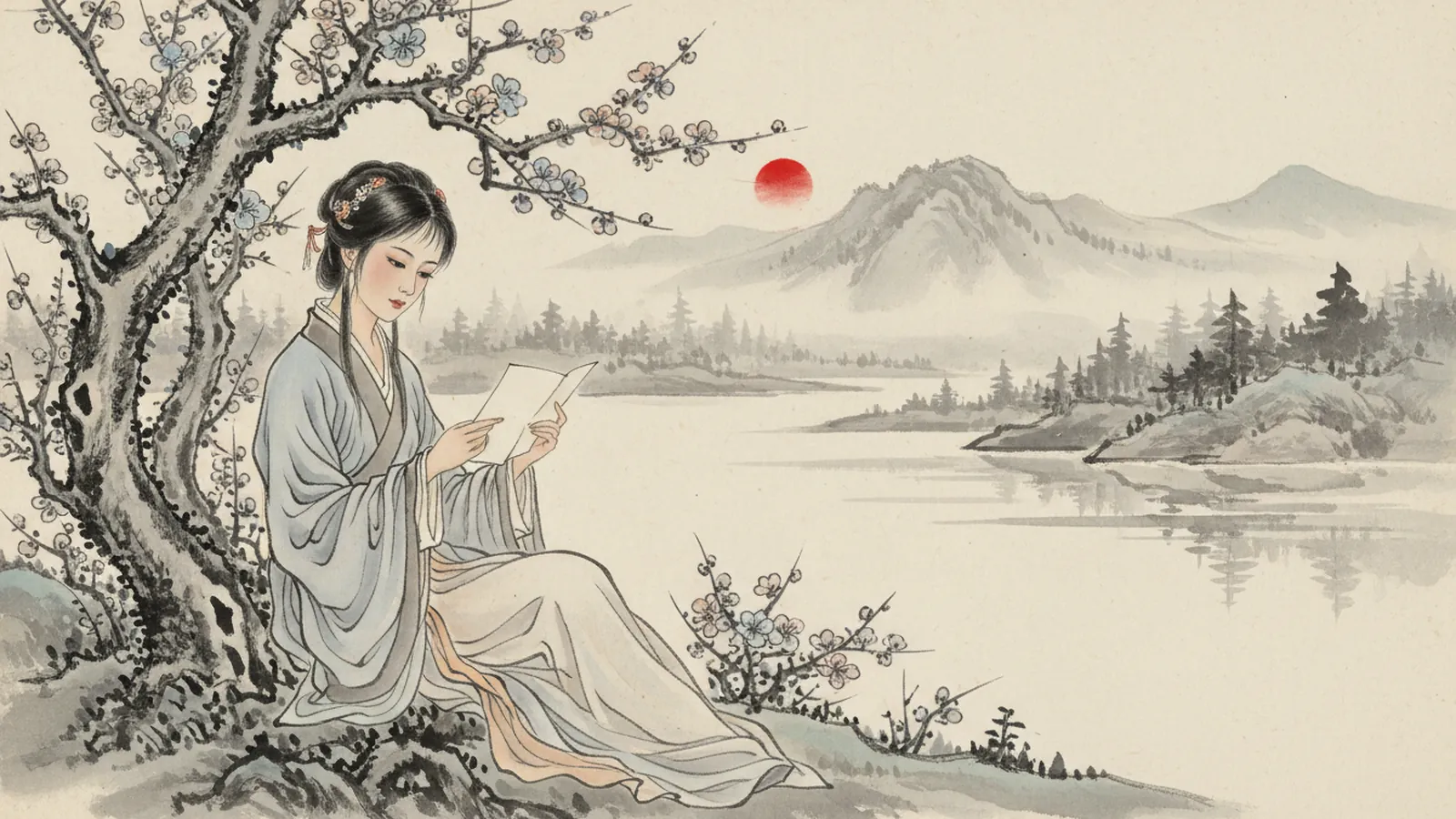
Sumimation is an Animation Studio style that paints your story as a traditional East Asian ink wash painting (sumi-e) and slowly brings it to life. Every scene starts as a painting made with dry-brush strokes on rice paper; then mist drifts, a boat glides, leaves fall. The result is a calm, poetic short film with realistic faces, and the paper texture is kept throughout the motion.
What does Sumimation look like?
Sumimation’s visual language rests on a few fixed rules:
- Paper and brush: slightly aged cream rice paper with visible fibres; bold dry-brush strokes in the foreground, mountains and pines dissolving into wet grey washes in the distance.
- A limited palette: black and grey ink, faint indigo and ochre washes on clothing or key objects, and one small red accent in each frame (a red sun, a lantern or a scarf).
- Empty space: generous areas of bare paper and an asymmetric, quiet composition.
- Detailed faces: characters are painted with a brush, but their faces stay detailed and readable with fine lines.
- Slow motion: one small, calm action per clip; the oar is pulled once, a crane lifts off the water, snow falls on a pine.
Fast action, fighting and quick camera spins break the brush texture, so the style does not use them. The camera moves as if over a painting: slow drifts along the scroll, gentle push-ins, slow rises towards the mountains.
How is Sumimation different from Wuxiamation?
Both styles draw on East Asian aesthetics, but they are built for different jobs. Wuxiamation’s Legend 2D variant tells an epic legend with gold leaf, bold graphic lines, a red-seal title and martial-arts heroics. Sumimation is calm, poetic and realistic in its faces: a fisherman, a traveller, a memory or a wish; silence and nature instead of fights and sagas. If your story is a heroic legend, pick Wuxiamation; if it is a poem or a moment of reflection, pick Sumimation. The styles are compared in the guide to choosing an animation style.
How do you make a Sumimation video?
- Open the Sumimation card, or go to /app/animation/sumimation in the app.
- Write your story. A person in nature or in an old town, a small journey or encounter and a calm ending work best: dawn, a boat coming home, falling snow, a lantern being lit.
- Add up to four characters if you like: write a name and a description, upload an image or let Sam draw them in this style. Adding characters is covered in the characters guide.
- Choose the speech type: narrator, dialogue, both or silent.
- Set the aspect, length, language, voice and music; write anything you don’t want to see in the Avoid field.
- Choose the quality, check the estimated price and start production.
Which quality tier should you choose?
| Tier | What it gives | Who can use it |
|---|---|---|
| Professional | Fast and economical | All plans |
| Premium | Best story and scene craft | All plans |
| Cinema | Richest light, texture and cinematic feel | Basic and Pro subscribers |
Cinema renders every scene with the cinema-grade video model and costs noticeably more tokens than the other tiers. If you are not a subscriber, the Cinema option shows a BASIC badge; tapping the badge opens the plans page.
How much does Sumimation cost?
Sumimation paints ink wash keyframes for every scene and animates them as video clips, so it costs more tokens than engine-drawn styles such as Ink Landscape. Before production the form shows a price cap, calculated with your plan multiplier (Free ×1.3, Basic ×1.0, Pro ×0.8). When production ends, the real usage is calculated and the difference goes back to your balance; failed jobs are refunded automatically too. See the animation cost guide for details and the pricing page for current list prices.
The Ink Wash Painting style in Image Studio and Design Studio
If you want a single ink wash painting rather than a moving film, the design styles in Image Studio and Design Studio include Ink Wash Painting. It uses the same visual language: rice paper, brush strokes, misty empty space and a single red accent. The main subject stays in the foreground; distant mountains and mist are added only when they suit the scene. All styles are in the design styles guide.
The two worlds connect: make an image in the Ink Wash Painting style in Image Studio and send it to Custom with the Turn into animation button on the result card, and you animate a single ink painting along a camera path you draw. Sumimation, by contrast, turns a whole story into scenes, narration and music.
Tips for better results
- Think of one calm action per scene, such as "the fisherman pulls the oar once and the boat glides".
- Avoid crowded, detailed modern scenes. A city can appear, but simplified, far away and veiled in mist.
- Text, calligraphy and signatures are already excluded by the style’s rules; you can also write colours or objects you don’t want in the Avoid field.
- Keep the narration sparse, like a short poem read slowly, with silences in between.
Frequently asked
Is there real motion in Sumimation, or does only the camera move? There is real motion. Each scene’s ink painting is animated as a video clip: mist drifts, water ripples, the character moves. The paper texture is kept throughout.
Why are the faces so detailed? It is a rule of the style. The brushwork stays loose, but eyes, wrinkles and beards are drawn with fine lines, so feelings read clearly and characters stay recognisable from scene to scene.
Can I use dialogue? Yes. You can choose narrator, dialogue, both or silent as the speech type. The options are explained in the narration and dialogue guide.
Which plan do I need for the Cinema tier? A Basic or Pro subscription. On the Free plan you can use the Professional and Premium tiers.
Can I turn an Ink Wash Painting image straight into a video? Yes. The Turn into animation button on the card of an image you made in Image Studio sends it to Custom, where you draw a camera path and make a 5, 10 or 15 second video.