
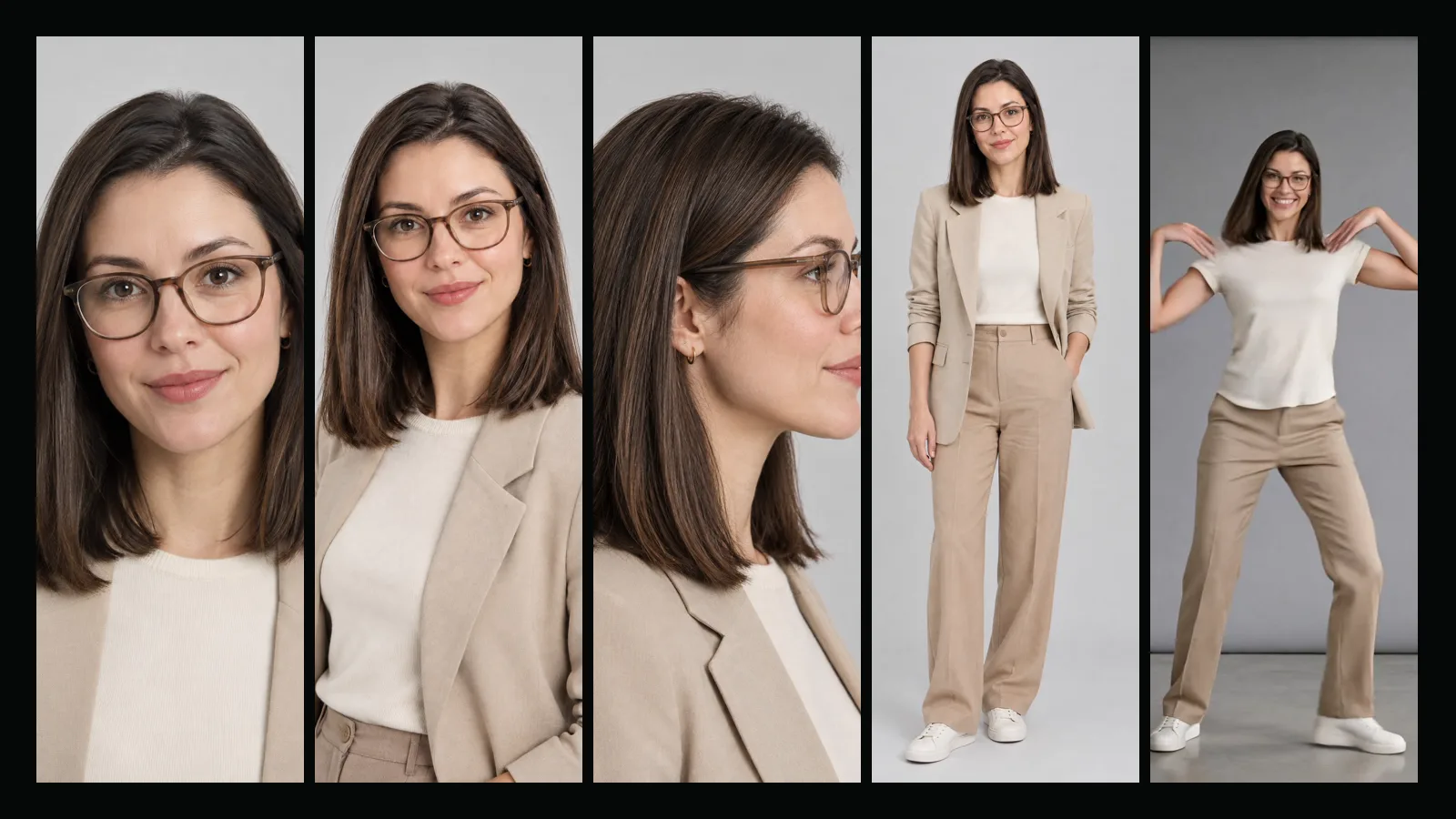
A consistent AI influencer is a character who can be recognized across many images and videos made at different times. Consistency is not a property of a single model; it comes from the way the production is organized. This article describes the building blocks, how AI Influencer Studio uses them and where their limits are.
What is a reference set?
A reference set is a small group of images of the same character from defined angles. In the studio it has four fixed views: a front portrait for identity, a full-body view for proportions and clothes, a three-quarter view and a side profile for the shape of the face and hair. Every later image or video receives some of these references, so the generator copies one agreed appearance instead of inventing a new one.
The order matters. The portrait is made first; all other views are made from the portrait. If the portrait was made from a real photo, the photo is used once more as an identity anchor and then never again.
Why a structured profile?
Free text is ambiguous: "dark hair" can become black or chestnut, and details drift from clip to clip. A structured profile turns the description into fixed choices, such as a hairstyle, a hair color or "glasses, sometimes", plus lists for wardrobe pieces, places and palette colors. In the studio, Sam converts a paragraph into this structure and only fills fields that the text actually supports. Fields that stay empty are not guessed at; they are decided once, when the reference set is made, and from then on the references carry them.
What do outfits and places add?
Recognition depends on more than a face. Recurring clothes and locations work like a costume department and a set. The studio stores wardrobe looks as outfit variants of the character and places as empty background images. A video can then reference "the character" plus "outfit 2" plus "the work corner", which keeps three things stable at once.
How does motion transfer fit in?
Writing a dance in words rarely gives a believable dance. Motion transfer solves this differently: it takes the movement from an existing clip and applies it to a still image of the character. The studio first redraws the first frame of the source clip with the character in the same pose and framing, then transfers the full motion onto that frame. Timing, gestures and camera feel come from the source; identity comes from the references.
What are the limits?
- One person per clip. When a source video shows several people, one of them is replaced.
- Very fast or unusual movements can blur hands or faces for a moment.
- Small details such as jewelry or text on clothing can vary between clips.
- Talking videos keep the face from the portrait; large head turns are not part of that format.
Choosing the Standard tier, giving clear references and keeping product or outfit images simple reduces most of these effects.
What does safety have to do with consistency?
A character that can be recreated endlessly needs clear rules about whose face it carries. The studio only allows a real photo with consent, checks every photo and uploaded video, limits characters to adults and keeps photos private. The safety guide describes each step.
Frequently asked
Is one reference image enough? One image keeps a face, but not proportions or the back of the head. Several fixed views make results more stable, which is why the studio always creates four.
Does a longer prompt make a character more consistent? Not by itself. Fixed references and a structured profile matter more than long descriptions, which tend to be interpreted differently each time.
Can consistency be guaranteed? No generator is perfectly consistent, but references, profiles and motion transfer together keep a character recognizable across many clips.